GLDP000158
External User Chronicle
Experimentally validated inverse design of FeNiCrCoCu MPEAs and unlocking key insights with explainable AI
Chronicle Description
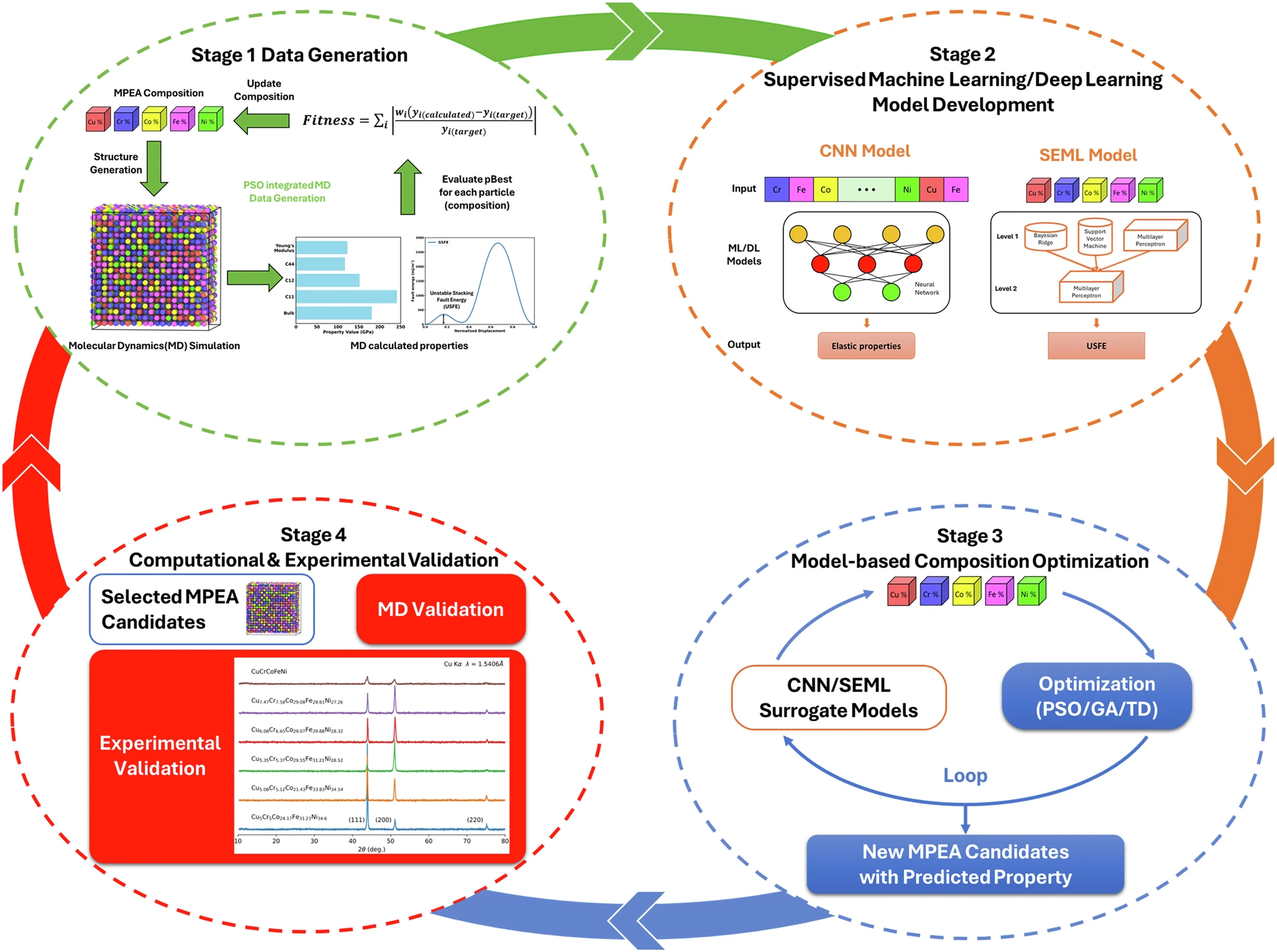
A computational work integrating a stacked ensemble machine learning (SEML) model and a convolutional neural network (CNN) model with evolutionary algorithms has been developed to identify new compositions of FeNiCrCoCu MPEAs with high bulk modulus and unstable stacking fault energies. The identified compositions were synthesized and tested for their crystal structures and mechanical properties (hardness and Young's modulus), resulting in single-phase face-centered cubic (FCC) structures. Additionally, the measured Young's moduli were in good qualitative agreement with computational predictions. The SHapley Additive exPlanations (SHAP) analysis of the SEML model revealed a relationship between elemental concentration and USFE. Meanwhile, SHAP analysis of the CNN models uncovered correlations between the local clustering of MPEA elements and their mechanical properties. This computational workflow, along with the fundamental insights gained, can be readily expanded and applied to the design of MPEAs with different elemental compositions, as well as to materials beyond MPEAs.
Associated Publications
Fangxi Wang; Allana G. Iwanicki; Abhishek T. Sose; Lucas A. Pressley; Tyrel M. McQueen; Sanket A. Deshmukh
npj Computational Materials
Data Files & Attachments
1 File(s) Available
| File Name | Description | File Type | Size | Action |
|---|---|---|---|---|
| Supporting Information | Supporting Information | DOCX | 11.61 MB | Login to Download |
Research Keywords & Tags
Related Chronicles