Dextran-block-poly(benzyl glutamate) block copolymers via aqueous polymerization-induced self-assembly
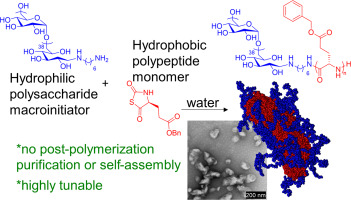
Combining polysaccharides with polypeptides enables growth of diverse nanostructures with minimal toxicity, low immune response, and potential biodegradability. However, examples of nanostructures combining polysaccharides with polypeptides are limited due to synthetic difficulties and related issues of solubility, purification, and characterization, with previous reports of polysaccharide-block-polypeptide block copolymers requiring methods such as polymer–polymer coupling and post-polymerization modifications paired with difficult purification steps. Here, we synthesized dextran-block-poly(benzyl glutamate) block copolymers in water via polymerization-induced self-assembly (PISA) to form nanostructures in situ, studying their morphologies using experimental methods and molecular modeling. Transmission electron microscopy revealed globular but non-spherical nanostructures throughout the PISA process, in contrast to PISA processes using poly(ethylene glycol) (PEG) as the hydrophilic block, which have shown a range of well-defined nanostructures. Coarse-grained molecular dynamics simulations on several homopolymers and block copolymers revealed that dextran chains interacted more strongly with each other compared to PEG, and that water packed less densely around dextran than around PEG. The combined experimental and computational results indicated that while dextran is hydrophilic, its interactions with itself led to the formation of unexpected nanostructures in this dextran-block-polypeptide system, suggesting that these interactions may be exploited to form unique nanostructures compared with other common hydrophilic blocks.
| File Name | Description | File Type | Size | Action |
|---|---|---|---|---|
| Simulation Parameter | Simulation Parameter | TXT | 4.29 KB | Login to Download |